
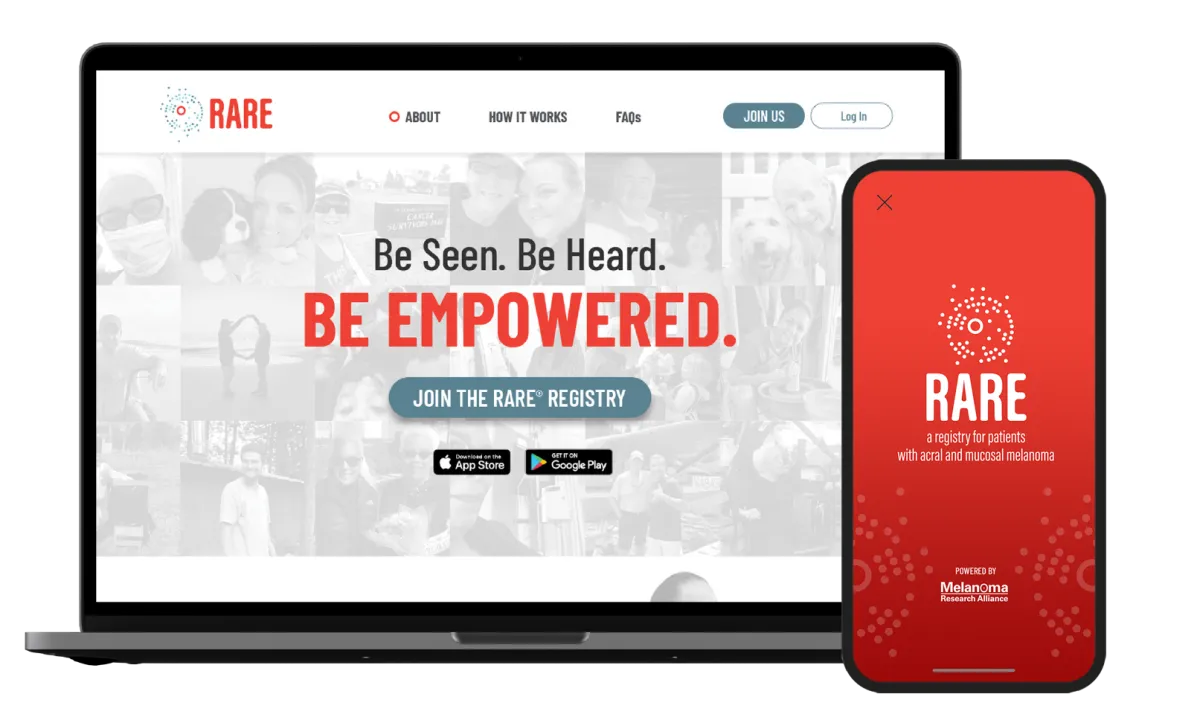
In October 2022, the Melanoma Research Alliance (MRA) launched RARE, a web-based, bidirectional, and interactive registry for patients facing acral, mucosal, and cutaneous melanoma. Since then and up to the time of publishing in 2026, nearly 750 participants have joined the RARE Registry to share their experiences with melanoma and to provide real-world data that helps researchers and clinicians to better understand these melanoma subtypes and improve clinical care.
Once enrolled, RARE participants are asked to complete multiple foundational surveys that focus on their demographics, disease history, genetics and tumor biomarkers, treatment history and timeline, lifestyle, and quality-of-life.
Additionally, participants can share their medical records, including pathology and test reports, through their RARE Registry portal. Soon, participants will have the ability to share their electronic health records (EHRs) through an interactive tool available on RARE. Participants can choose what information they would like to share through both surveys and medical records.
RARE allows participants to explore how their experiences compare with those of others in the registry. Participants may also elect to receive notifications about melanoma-focused webinars, clinical trials, and recent advances in research, as well as blog posts featuring analyses of RARE Registry data.
Learn more about the RARE Registry, including how to enroll and participate:
Melanoma represents a challenging, multifaceted disease. It arises from cells called melanocytes that are located in different parts of the body, including the skin, eyes, mucosal surfaces, palms of hands, and soles of feet, among others. Depending on their location, melanocytes can give rise to different subtypes of melanoma, which can have shared but also distinct biologies that can make them difficult to treat. Critical knowledge gaps remain about how these melanoma subtypes develop, progress, can be treated, and impact patients’ quality-of-life.
The RARE Registry was created to bring the patient experience into research by collecting comprehensive, real-world data directly from patients into a singular resource that researchers and clinicians can use to address longstanding gaps in our understanding of these melanoma subtypes. The MRA began work in 2020 to launch RARE. Its vision was inspired by patient advocates diagnosed with acral and mucosal melanoma, and was intentionally designed as a collaborative effort involving patients, caregivers, clinicians, and researchers.
“The RARE Registry was the idea of patients and has been co-created with a group of patients, caregivers, physicians, and researchers. RARE is an opportunity for patients with acral, mucosal, and cutaneous melanoma to share data about their diagnosis journey, treatments they were offered, and information on their quality-of-life. It’s a way for people to be actively involved and engaged in research,” says Dr. Joan Levy, Chief Science Officer, MRA, and PI of RARE. “There’s real power and strength in each individual facing a rare melanoma sharing their story.”
Unlike other registries that typically focus on a singular point in time (e.g., baseline survey), RARE will ask participants to provide data over time and will ask important, but often neglected, questions about their quality-of-life. This is important because preserving – and even advancing – quality-of-life is critical to patients and is often overlooked in clinical research.
“The RARE Registry is an opportunity for patients to help shape the future of melanoma research. By sharing their experiences with melanoma, patients help investigators and clinicians to identify research priorities, thus accelerating efforts towards improving care and quality-of-life for current and future patients.”

Acral and mucosal melanomas are rare and difficult-to-treat forms of the disease, and significant challenges remain for nearly 50% of cutaneous melanomas that do not respond to current treatments. As such, understanding who is affected by melanoma and how the disease affects them individually, is essential for researchers and clinicians to uncover how these forms of melanoma develop, progress, and can be treated more effectively. By voluntarily sharing information through the RARE Registry, patients can help ensure that the field is focused on aspects of the disease that are most important to those affected.
A major goal of RARE is to provide researchers and clinicians with access to the RARE Registry’s data in order to facilitate studies on melanoma that aim to improve patient care and outcomes. Currently, MRA is working on developing a data analytics platform that will provide approved researchers with access to RARE’s de-identified, aggregate data.
The MRA is also proud to release the first-ever RARE Registry Data Report entitled “Patient Voices Empowering Research”, highlighting insights from participants who have generously shared their experiences with acral, mucosal, and cutaneous melanoma.
Advancing our understanding of rare subtypes of melanoma, such as acral and mucosal melanoma.
Read the ReportThe RARE Registry is an initiative led by the MRA. MRA was founded in 2007 and is the largest non-profit funder of melanoma research worldwide. Since its inception and into 2026, MRA has committed over $200 million, and leveraged an additional $500 million from outside sources, to fund life-saving melanoma research necessary to achieve its mission of ending suffering and death due to melanoma.
RARE was inspired by and developed in close collaboration with a community of rare melanoma patient advocates and caregivers, whose lived experiences helped shape its vision and priorities. To further guide its mission, RARE established an Oversight Committee composed of patients and caregivers, alongside a multidisciplinary group of medical advisors, including dermatologists, pathologists, oncologists, scientists, and surgeons, with experience spanning basic and translational research, epidemiology, quality-of-life research, and clinical trial development.
Together, this collaborative structure ensures that RARE’s mission remains responsive to both the patient experience and the evolving needs of the scientific and medical communities in order to advance research that can bring meaningful change to the melanoma community.
Learn more about RARE’s Oversight Committee.
The RARE Registry is built to protect your data. It is compliant with HIPAA and GDPR. You may withdraw from the registry at any time. Please review our Terms and Conditions, Privacy Policy, and Informed Consent Document.
Learn more about the RARE Registry at raremelanoma.org.
For patients with uveal (ocular) melanoma, another rare melanoma subtype that develops in the uveal tract of the eye, MRA encourages participation in established ocular melanoma registries through A Cure In Sight and the Melanoma Research Foundation.


